
Every step links back to that moment in the video
Designed by Chef Ricky Cheung, this home air fryer roast pork belly recipe streamlines traditional lengthy drying and marinating. By boiling in seasoned brine and soaking the skin in red rice vinegar with baking soda, it delivers a honeycomb crispy crackling and juicy meat effortlessly.
Estimated timing — actual time may vary with cooking speed and heat.
What makes this version work
Simmer in salted sugar brine for 1 hour to simultaneously season meat and soften skin collagen.
Prick skin diagonally at 45 degrees to loosen surface fibers without piercing the fat layer.
Soak skin on kitchen paper in red vinegar and baking soda to ensure even tenderizing for blistering.
Line the foil box base with damp kitchen paper to insulate lean meat from drying out.
Ingredients
Tap to check off — your progress is saved
Simmering & Brining
- Pork Belly 400gChoose cut near soft bone for balanced fat and lean layers
- Water 2000gAbout 2L, enough to fully submerge the pork
- Salt 200g
- Sugar 100g
Skin Crisping Solution
- Red Rice Vinegar 100gWhite vinegar or rice vinegar can be substituted, though red rice vinegar yields a richer amber color
- Baking Soda 10g
Roasting Wraps & Aids
- Aluminum Foil to tasteFold into a snug box around the meat slab
- Kitchen Paper Towel to tasteOne sheet for vinegar soaking, one sheet dampened for the foil box bottom
Equipment
- Dual-speed Air Fryer Oven (or standard air fryer)
- Deep saucepan or skillet with lid
- Meat pricker (or stainless fork / skewers)
Steps
Select and trim pork belly thickness
 Time 5 min
Select pork belly cut near the soft bone for optimal fat-to-lean distribution. Inspect the meat slab and trim off any unevenly high spots so the slab maintains an even thickness for uniform roasting.
How to tellEvenly layered pork belly trimmed to a uniform flat thicknessWatch at 2:18Simmer in salted sugar brine to soften collagen and season
 Time 60 minHeat Medium-low heat
Bring 2000g water, 200g salt, and 100g sugar to a boil in a deep pot. Add the pork belly, cover with a lid, and gently simmer over medium-low heat for 1 hour. This single step tenderizes the meat, seasons it completely, and gelatinizes skin collagen.
How to tellGentle small bubbling surface, covered with lidCommon mistakeKeep the pot covered and heat gentle to avoid excess evaporation making the brine overly salty.Watch at 3:40Score and trim meat side to prevent warping
 Time 5 min
Remove the boiled pork belly. As the cooked slab naturally curves, make shallow cuts across the meat side to release tension and trim down any high spots so the slab sits completely flat.
How to tellScored meat surface resting flat against the cutting boardWatch at 4:35Prick skin diagonally at a 45-degree angle
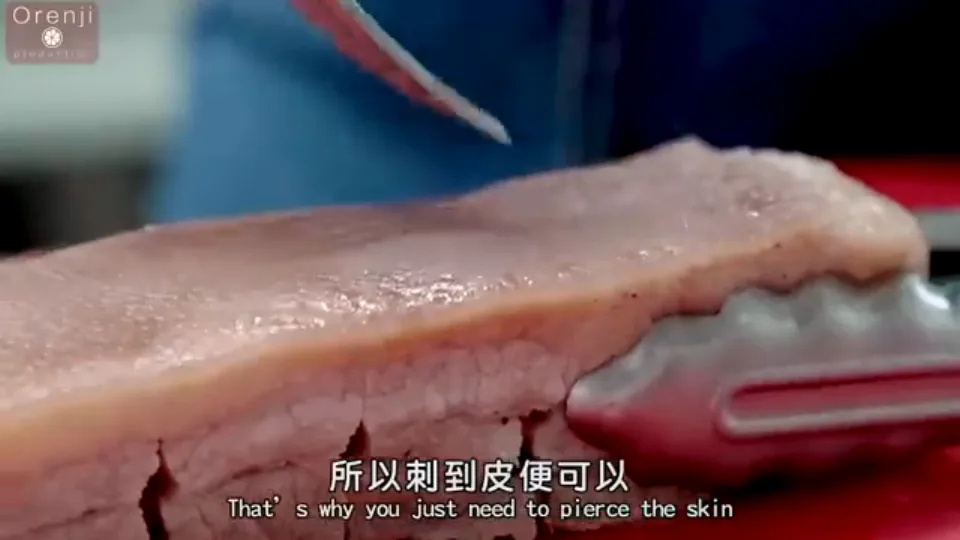 Time 5 min
While the skin is warm and softened from boiling, use a meat pricker or fork to pierce the skin rapidly at a 45-degree diagonal angle across both directions. This breaks the tough surface fibers without penetrating into the fat layer.
How to tellSkin surface evenly covered with fine punctures while remaining softWatch at 5:42Mix red rice vinegar and baking soda solution
 Time 2 min
Pour 100g red rice vinegar into a shallow tray and add 10g baking soda. The acid and alkali will fizz actively; stir until the baking soda is completely dissolved without any gritty residue.
How to tellEffervescent bubbling on contact, turning into a smooth dissolved liquidWatch at 6:35Line with kitchen paper and soak pork skin
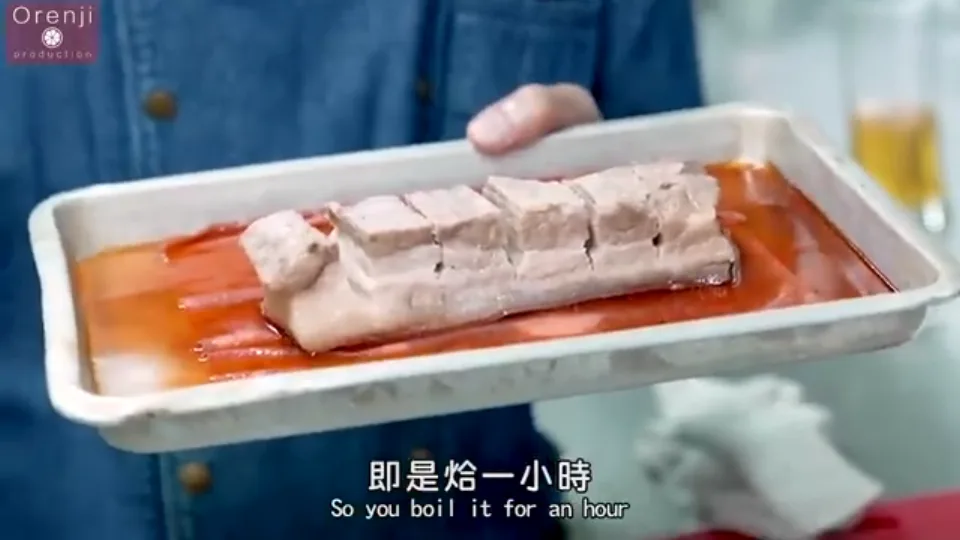 Time 60 min
Lay a sheet of kitchen paper flat into the tray to soak up the vinegar solution, then place the pork belly skin-side down onto the paper. The paper prevents the heavy meat from squeezing away liquid, ensuring uniform contact for 1 hour.
How to tellKitchen paper fully saturated with red vinegar, with skin resting flush on topWatch at 7:48Fold foil box and line base with damp kitchen paper
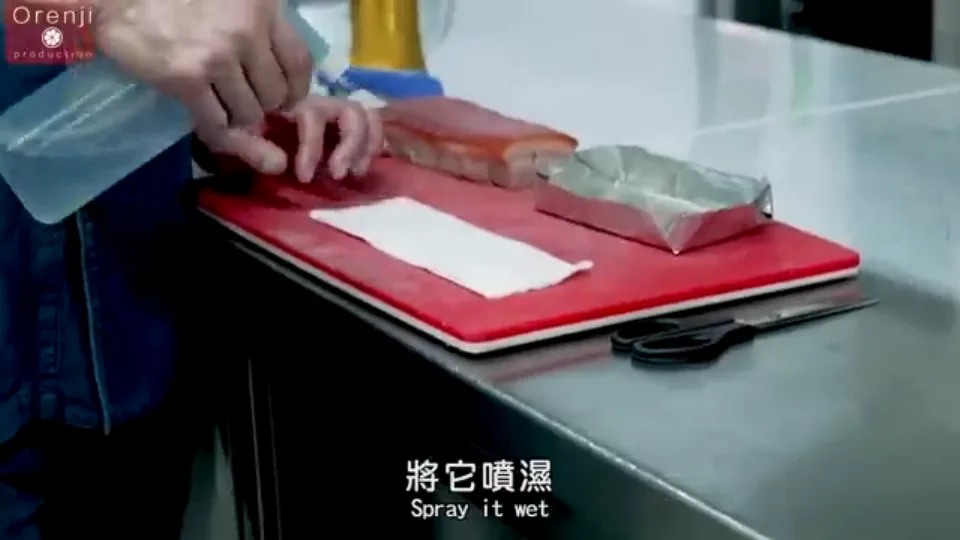 Time 5 min
Measure aluminum foil and pinch the four corners to fold a snug rectangular tray around the pork belly, leaving only the skin exposed. Spray another sheet of kitchen paper thoroughly wet with water, line the bottom of the foil box, and place the meat inside to insulate lean meat.
How to tellFoil snugly hugging all four sides with wet paper lining the bottom baseWatch at 9:25First air-fry stage: Low fan speed to dry skin surface
 Time 10 minHeat 185°C - 200°C Low Air Speed
Place the foil-wrapped pork belly into the air fryer basket. Set temperature between 185°C and 200°C on low fan speed and cook for 10 minutes to gently dry out surface moisture on the skin.
How to tellSkin surface moisture dried, appearing slightly taut and matteWatch at 10:45Second air-fry stage: High fan speed to blister skin
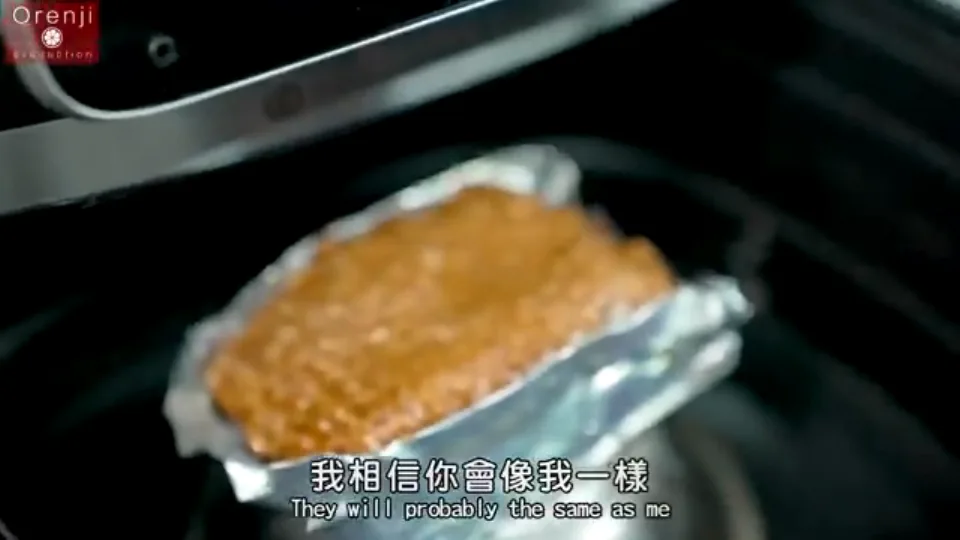 Time 30 minHeat 185°C - 200°C High Air Speed
Keeping the same temperature (185°C–200°C), switch the air fryer to high fan speed and roast for about 30 minutes. The powerful hot air circulation rapidly blisters the softened skin into an evenly golden, crunchy honeycomb crust.
How to tellEntire skin uniformly golden and blistered into a honeycomb cracklingWatch at 12:10Rest, slice and serve
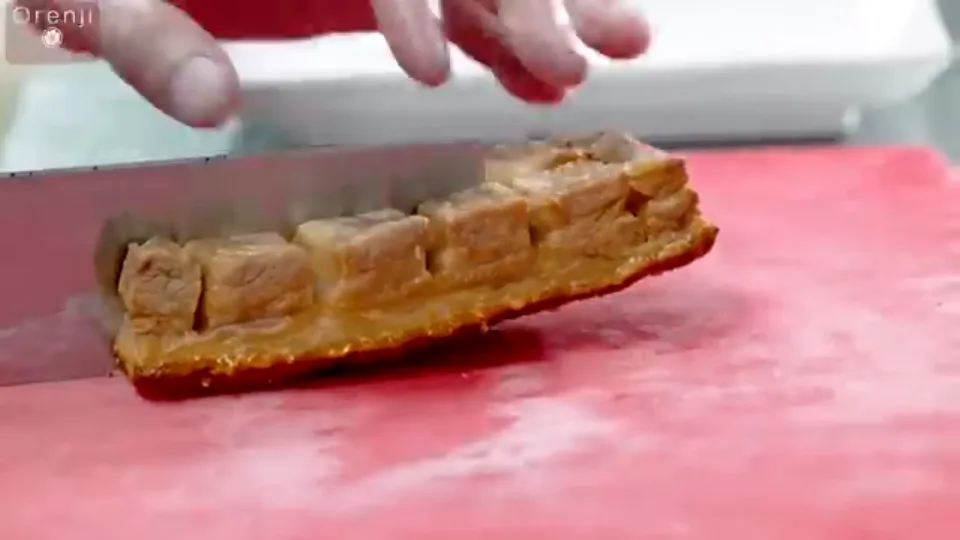 Time 5 min
Remove the roasted pork belly from the air fryer and rest briefly. Slice firmly with a sharp knife into bite-sized cubes. The skin shatters crisply while the meat underneath remains moist and succulent.
How to tellAudible shattering crunch when slicing, revealing juicy meat layersWatch at 13:00
Chef's secrets
Boil & brine combined into one effortless step
Combines blanching, simmering, and brining into a single step. Simmering in a 10:1 water-to-salt ratio with sugar for 1 hour deeply seasons the meat while thoroughly softening the skin collagen so it puffs up effortlessly later.
Diagonal 45-degree skin pricking for superior penetration
Softened cooked skin is much easier to pierce. Angling the pricker at 45 degrees breaks tough surface fibers with far better penetration than 90 degrees, without piercing deep fat layers that might flood pores.
Kitchen paper liner ensures uniform vinegar absorption
Red rice vinegar and baking soda work together to soften skin fibers. Because heavy pork belly rests flush against the tray bottom and pushes liquid aside, lining with saturated paper towel ensures complete, uniform contact across the whole surface.
Damp paper towel heat shield keeps lean meat juicy
Air fryer hot air is intense and foil transfers high conductive heat. Placing a water-dampened paper towel beneath the pork insulates the bottom lean meat, keeping it succulent throughout the 40-minute roast.
Storage & reheating
Fridge
Store in an airtight container in the refrigerator for 2-3 days.
Freezer
Freezing is not recommended as thawed crackling loses its crispness.
Reheating
Reheat in the air fryer at 180°C (350°F) for 5-8 minutes to restore skin crispness.
FAQ
Can I replace red rice vinegar with white vinegar or rice vinegar?
Yes. While white vinegar or rice vinegar has sufficient acidity to soften the skin (use the same 100g), red rice vinegar adds natural color and aroma that yields a richer golden-amber roasted crust.
How do I adapt this if my air fryer does not have dual fan speeds?
For standard single-speed air fryers, roast at 180°C (355°F) for 10 minutes to dry the skin, then increase to 200°C (400°F) for 25-30 minutes until the crackling is blistered and puffed.
Why avoid piercing deep into the fat layer like traditional recipes?
Piercing too deeply releases excessive fat that clogs skin pores. With Ricky's method of pre-softening in brine and vinegar, light diagonal pricking is enough for air circulation to trigger a crisp honeycomb blister.
Do I need to scrape off charred skin after roasting?
Because of the two-stage air drying and moisture protection, the crackling roasts evenly to a golden brown with minimal burning. If edges darken slightly, simply scrape gently with a knife blade.
Nutrition
Estimated per serving. Actual values vary with ingredients and portion size.
No time to cook?
The same wok-fired cooking, already made for you at Bryt Kitchen.
See the menu