
Video recipe
Hong Kong Jenny Butter Cookies (Vanilla, Coffee & Chocolate)
Crisp. Buttery. Melt-away.
Adapted from siZning
Every step links back to that moment in the video
Hong Kong's famous Jenny Bakery butter cookies are prized for a crisp first bite that immediately melts away on the tongue. Baking channel siZning tested this formula repeatedly to capture that signature texture across three classic flavors—vanilla, coffee, and Valrhona cocoa—using unsalted butter, powdered sugar, and cornstarch. Mixed entirely with a spatula rather than whipped, the dough stays thick enough for an 8-point star tip to pipe tall, ruffled ridges that hold their shape in the oven.
Estimated timing — actual time may vary with cooking speed and heat.
What makes this version work
Mixed entirely with a spatula without whipping air, combining powdered sugar and cornstarch for a delicate snap that melts on the tongue.
A purposefully firm dough piped through a cloth bag and 8-point star tip (853K) keeps its ruffled ridges crisp without spreading flat.
One foundational ratio adapts cleanly into vanilla, coffee, and Valrhona cocoa batters for a classic three-flavor cookie tin.
Ingredients
Tap to check off — your progress is saved
Vanilla Cookie Dough (16 cookies)
- Unsalted butter 115gSoftened at room temperature until no longer cool (Anchor unsalted butter used in video)Cultured butter can be used instead
- Powdered sugar 55g
- Salt to tasteA pinch
- Whole egg 10gBrought to room temperature and beaten before weighing
- Vanilla extract 3g
- Cake flour 135gSifted
- Cornstarch 30gSifted
Coffee Cookie Dough (16 cookies)
- Unsalted butter 115gSoftened at room temperatureCultured butter can be used instead
- Powdered sugar 55g
- Salt to tasteA pinch
- Whole egg 10gRoom temperature, beaten
- Coffee essence 4gSunin coffee flavor essence used in video
- Cake flour 135gSifted
- Cornstarch 30gSifted
Chocolate Cookie Dough (16 cookies)
- Unsalted butter 115gSoftened at room temperatureCultured butter can be used instead
- Powdered sugar 55g
- Salt to tasteA pinch
- Whole egg 10gRoom temperature, beaten
- Vanilla extract 3g
- Cake flour 127gSifted
- Cornstarch 30gSifted
- Unsweetened cocoa powder 8gSifted (Valrhona cocoa powder used in video)
Equipment
- 8-point open star piping tip (size 853K)
- Cloth piping bag
- Silicone spatula and fine-mesh sieve
- Teflon baking sheet liner and baking pan
- Wire cooling rack
Steps
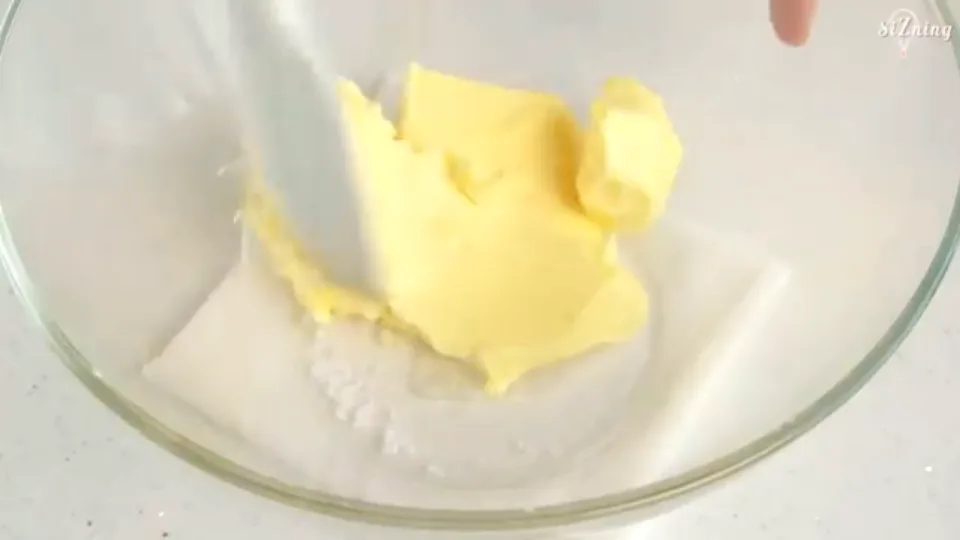
Cream the room-temperature butter with salt using a spatula
 Time 3 min
Bring the egg and unsalted butter to room temperature ahead of time until the chill is gone, and preheat the oven to 160°C. Place the softened butter in a clean bowl with a pinch of salt and press smoothly with a silicone spatula until supple.
How to tellThe butter forms a smooth, lump-free paste that spreads effortlessly under the spatula.Watch at 0:35Fold in the powdered sugar until fully incorporated
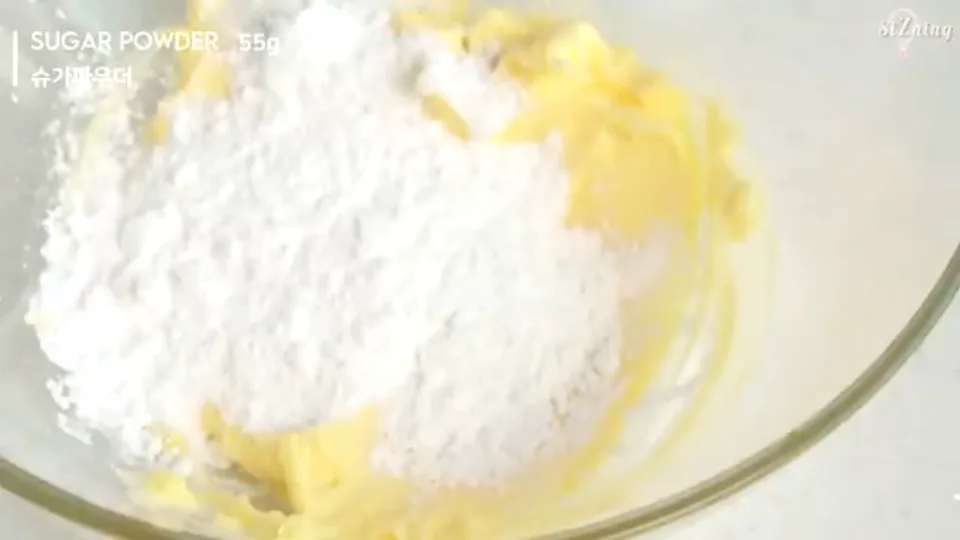 Time 4 min
Add 55 g powdered sugar on top of the softened butter. Fold and press against the bowl with the spatula until the sugar is completely absorbed and no dry white powder remains.
How to tellThe butter and powdered sugar come together into a glossy, uniform pale-yellow cream.Watch at 0:41Mix in the beaten egg and flavor extract until emulsified
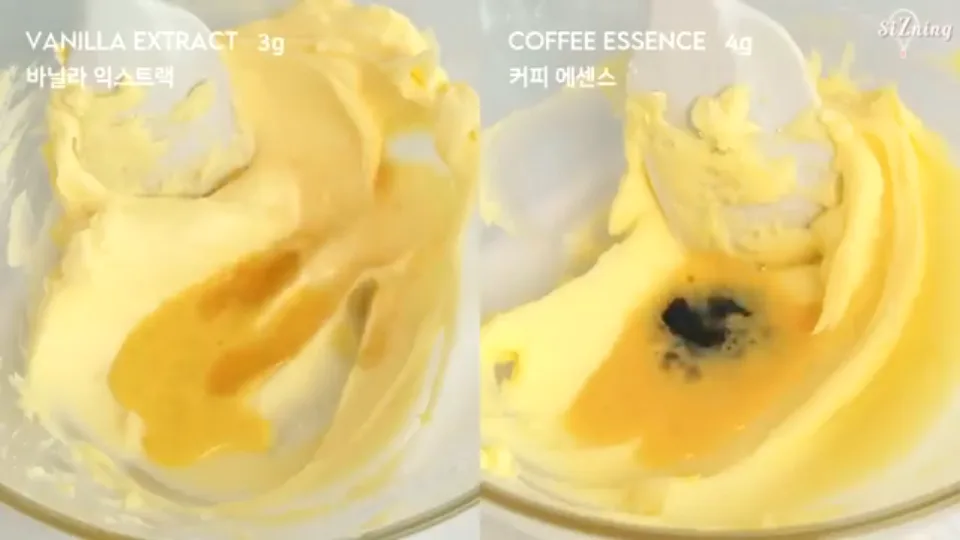 Time 4 min
Add 10 g room-temperature beaten egg along with the corresponding flavoring (3 g vanilla extract for the vanilla and chocolate batters, or 4 g coffee essence for the coffee batter). Stir steadily with the spatula until fully emulsified.
How to tellThe mixture looks smooth and glossy without any curdling or liquid separation.Watch at 0:58Sift in the dry ingredients for each flavor
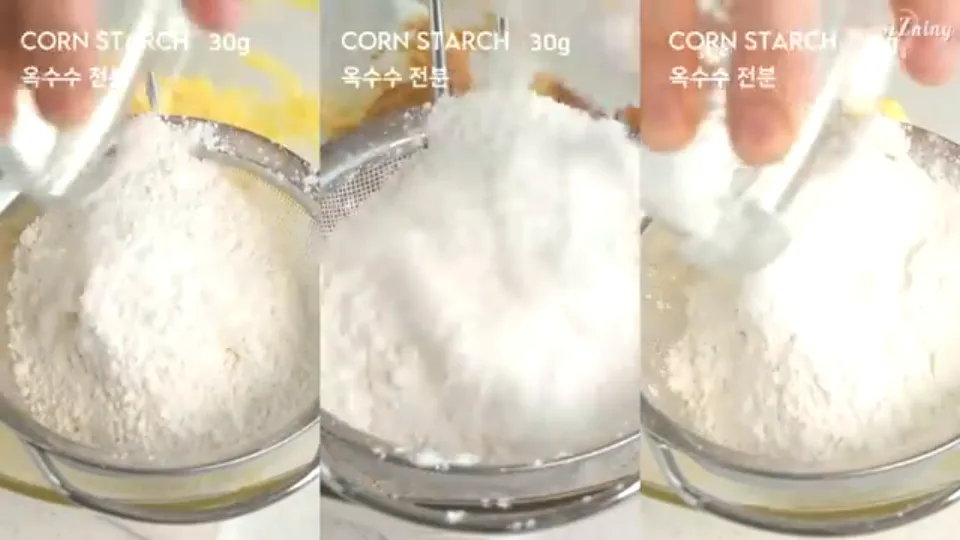 Time 3 min
Once the butter mixture is smoothly emulsified, set a sieve over the bowl and sift in the dry powders for each flavor (135 g cake flour + 30 g cornstarch for vanilla and coffee; 127 g cake flour + 30 g cornstarch + 8 g cocoa powder for chocolate).
How to tellThe sifted powders fall in a light, lump-free layer over the butter mixture.Watch at 1:12Fold with a spatula until smooth and check dough consistency
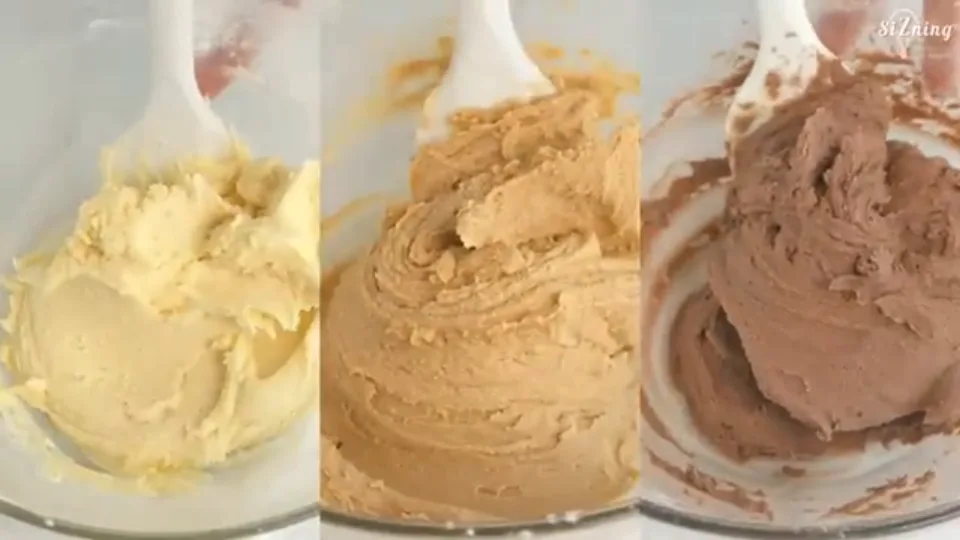 Time 6 min
Cut and press with the spatula until no dry flour is visible and a smooth, slightly thick dough forms. The dough must retain enough body and stiffness to hold the signature Jenny cookie ridges during baking.
How to tellWhen lifted on the spatula, the three doughs are thick and smooth, holding their edges rather than slumping.Common mistakeIf the dough is too soft, the cookies will spread too far sideways in the oven and lose their ridges.Watch at 1:50Fill cloth piping bags fitted with an 8-point star tip
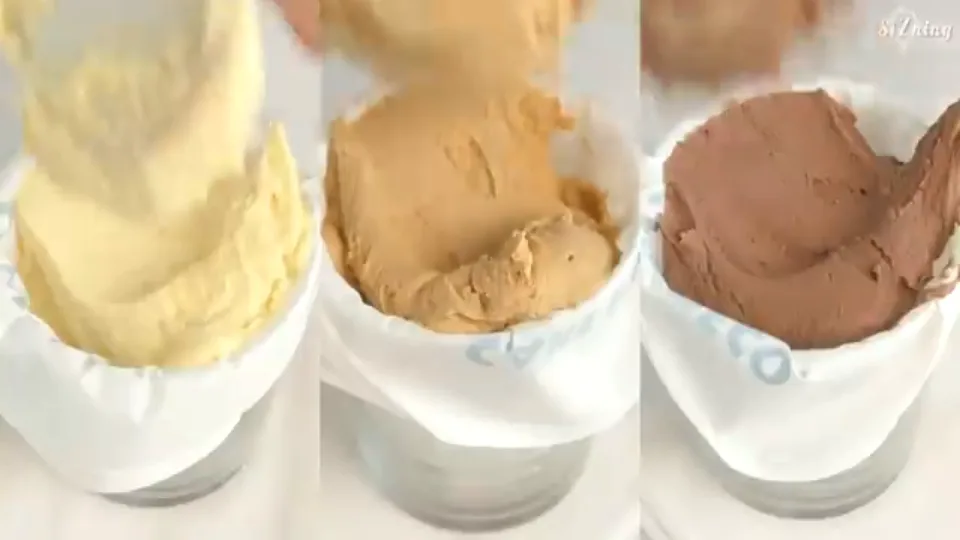 Time 3 min
Fit cloth piping bags with an 8-point open star tip (size 853K), transfer the finished vanilla, coffee, and chocolate doughs inside, and push toward the tip to remove air pockets.
Common mistakeAlways use a cloth piping bag. Because this dough is firm, a disposable plastic bag can burst under pressure or pop the nozzle out.Watch at 1:52Pipe from 1 cm above the sheet, lifting and twisting at the top
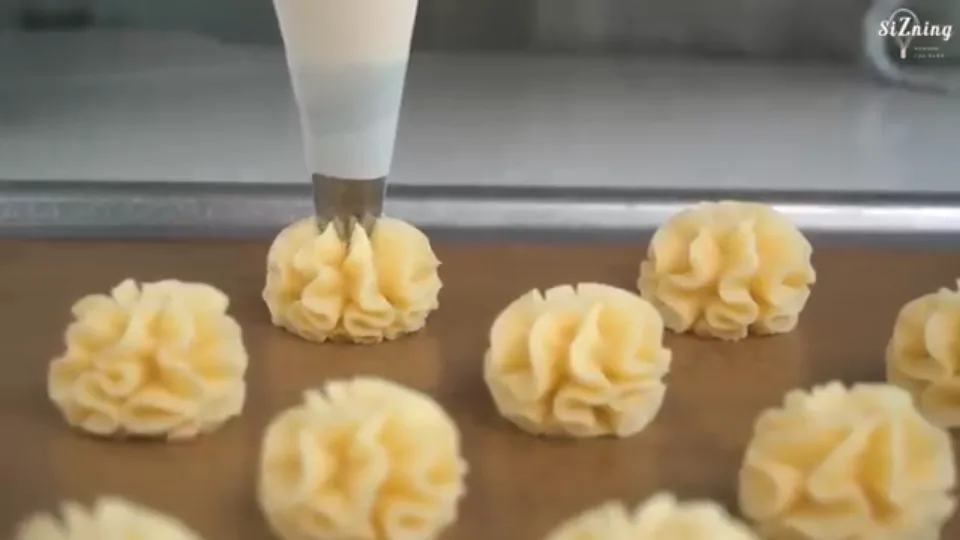 Time 7 min
Line a baking pan with a Teflon sheet. Hold the nozzle about 1 cm above the surface and squeeze steadily so the ruffled pleats build up along the sides. Lift the bag upward at the same speed as the dough emerges, then twist and lift the tip off cleanly at the end. Space the cookies evenly across the pan.
How to tellEach cookie has well-defined ruffled pleats around the sides and a neat, flat top.Watch at 2:10Bake in the preheated oven at 150°C for 30 minutes
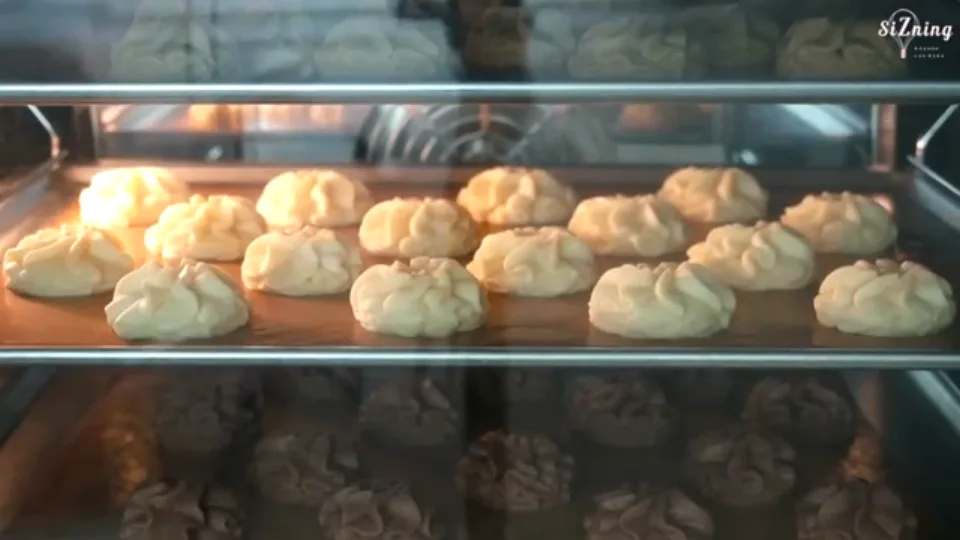 Time 30 minHeat Oven 150°C (300°F)
If the piped dough looks slightly soft, chill the pan in the refrigerator for about 20 minutes first. Bake in the thoroughly preheated oven at 150°C for 30 minutes.
How to tellThe cookies set evenly in the oven while their star ridges stay sharp without spreading.Watch at 2:20Cool completely on a wire rack after baking
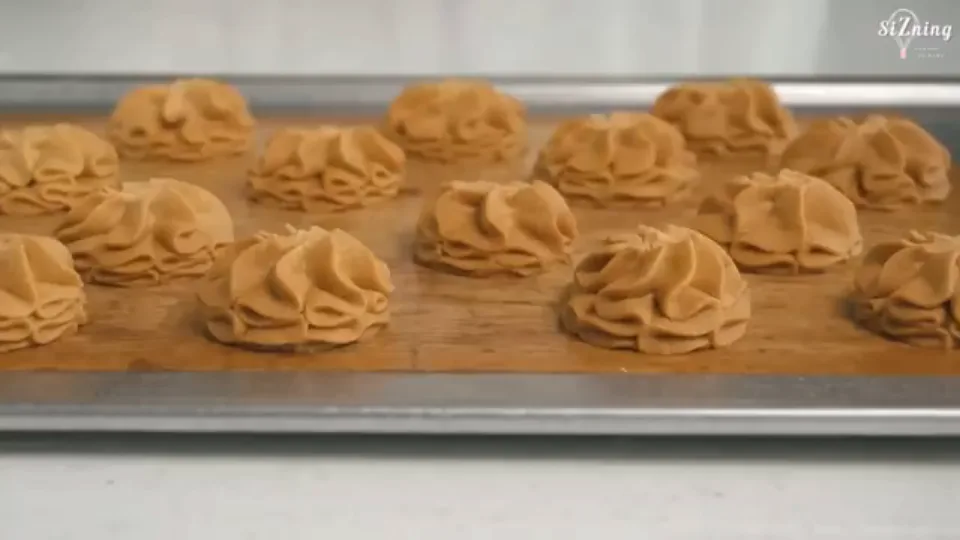
Once baked, remove from the oven and transfer the cookies onto a wire cooling rack to cool completely. After residual steam escapes and the crumb sets to a crisp, melt-away texture, pack the three flavors into a cookie tin.
How to tellThe edges show an even golden hue; once cooled, they snap cleanly on the first bite and dissolve softly in the mouth.Watch at 2:26
Chef's secrets
Dough consistency makes or breaks the ridges: keep it slightly thick
The hallmark of Jenny cookies is their tall, ruffled star ridges. By mixing exclusively with a spatula and avoiding over-aeration, the finished dough stays relatively thick. If warm room temperatures make the dough too soft, it will puddle sideways in the oven—chilling the piped tray for 20 minutes before baking locks the ridges in place.
Hover 1 cm up, lift at extrusion speed, and twist off cleanly
Three piping mechanics create the signature flower shape: hold the 8-star tip about 1 cm above the Teflon sheet so the pleats fold outward naturally; lift the bag at the exact speed the dough emerges; and finish with a quick twist of the nozzle so the top bakes flat and neat instead of leaving a scorched peak.
Preheat to 160°C, then bake low and slow at 150°C for 30 minutes
The oven is preheated slightly higher to 160°C to compensate for heat loss when opening the door, then baked at 150°C for a full 30 minutes. Baking low and slow drives moisture out from the center of the thick piped rosettes without over-browning the exterior.
Storage & reheating
Fridge
Store completely cooled cookies in a tightly sealed container or tin at room temperature for up to 1 week.
Freezer
For longer storage, seal tightly and freeze for up to 1 month.
Variations
Upgrade with cultured butter
While the video uses Anchor unsalted butter for a classic Hong Kong bakery taste, the creator notes that you can substitute an equal weight of unsalted cultured butter for a deeper, subtly tangy dairy aroma.
FAQ
Why must I use a cloth piping bag instead of a disposable plastic one?
To keep the star ridges sharp in the oven, Jenny cookie dough is noticeably firmer than standard piped cookie batter. Disposable plastic bags frequently burst at the seams or push the nozzle out under that pressure, so a sturdy cloth piping bag is essential.
Why did my cookies spread out and lose their ridges in the oven?
Spreading happens when the dough is too warm and soft. Soften the butter only until the chill is gone and a spatula can press through it. If the piped rosettes look soft on the tray, chill the pan in the fridge for about 20 minutes before baking so the fat firms up.
Which piping tip size is used for this recipe?
The video uses an 8-point open star tip, model 853K. Its wide 8-pronged opening creates deep, spaced-out pleats that closely match traditional Hong Kong Jenny Bakery cookies.
Should I preheat the oven to 160°C or 150°C?
Preheat the oven to 160°C (320°F) before mixing, then bake at 150°C for 30 minutes once the tray goes in. Preheating 10°C higher offsets the temperature drop when opening the oven door, helping the ridges set right away.
Nutrition
Estimated per serving. Actual values vary with ingredients and portion size.
No time to cook?
The same wok-fired cooking, already made for you at Bryt Kitchen.
See the menu