
Kitchen Blog · Philosophy
We Looked at Supermarket Shelf Fees, Then Went Back to Making Beef Balls
We once considered putting our beef balls on large Canadian supermarket shelves. After reading the list of listing fees, invoice deductions, promo spend and EDI fines, we kept our route short and put that budget back into the ingredients.
Published November 26, 2026 · Updated November 26, 2026

We once wondered whether we should try putting our beef balls into large Canadian supermarket freezers.
After reading the industry fee sheet, we decided to go back to making beef balls instead.
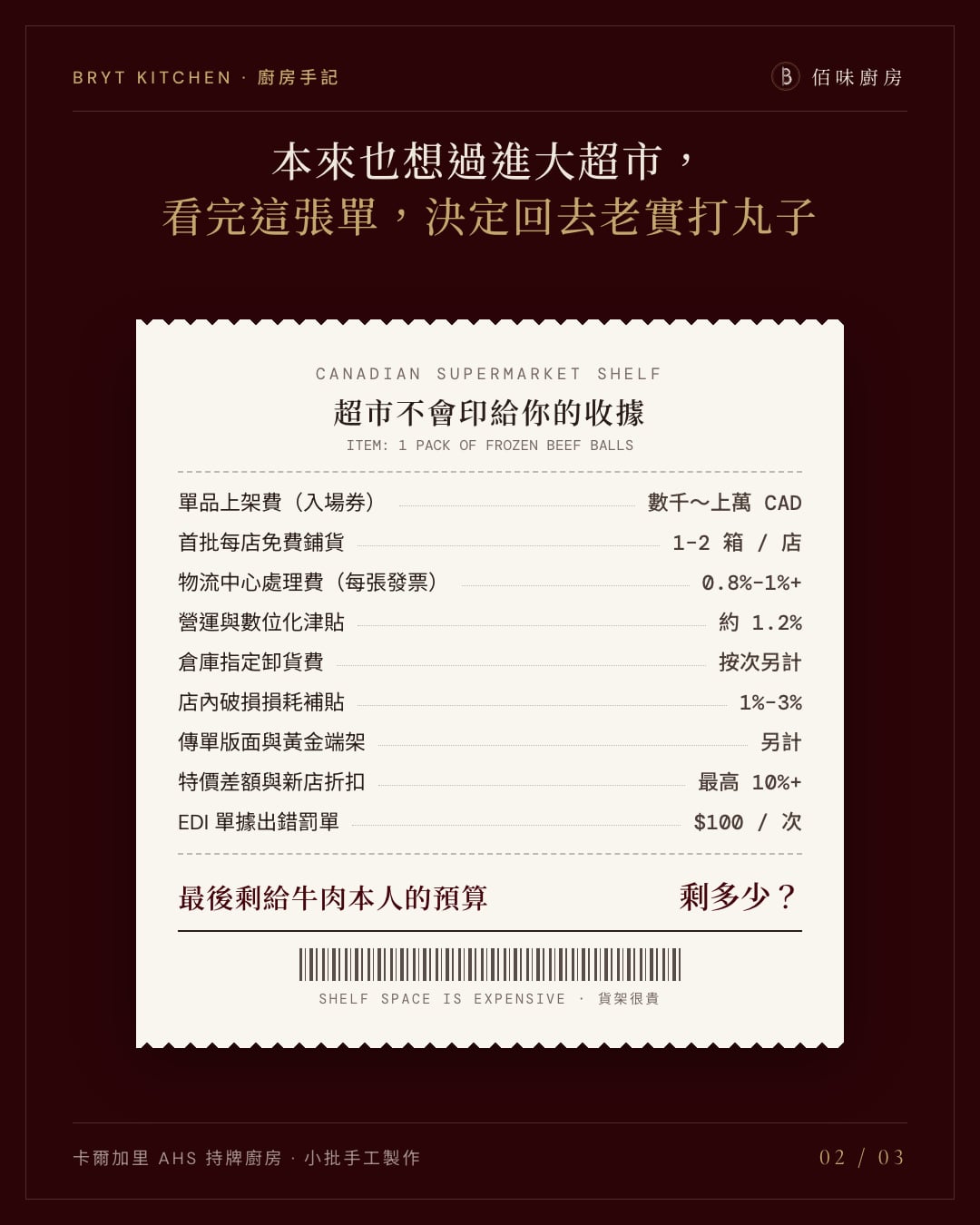
At national chains, a listing fee for a single SKU can run from several thousand to tens of thousands of Canadian dollars, with one to two free cases per store often expected on the first order. That entry ticket alone would buy several batches of Alberta beef for our kitchen.
Once shipments start, each invoice carries recurring deductions: supply chain handling fees (about 0.8% to 1% or more), operational and digital allowances (around 1.2%), warehouse lumper fees, and a 1% to 3% spoilage allowance. Weekly flyers and end-cap displays cost extra, sale discounts are largely funded by the supplier, new store openings often ask for roughly 10% off, and an EDI invoice mistake can trigger a $100 CAD fine.
For a small kitchen like ours, watching the pot is safer than fighting paperwork.
Food safety licensing and product liability insurance are baseline obligations we never skip—we operate under an Alberta Health Services (AHS) licence in Calgary. It is the extra shelf overhead, along with the heavy operating costs of large online group-buy channels, that we neither want to pay nor pass along.
Since we cannot afford a prime end-cap, we keep the route short: direct orders on our website and partnerships only with value-aligned, fairly priced group-buy hosts. What stays out of channel fees goes back into Alberta pork and beef, natural spices, and small-batch handmade Eastern food—frozen right after making, with no preservatives.
We will not guess anyone else's recipe. Next time you pick up a bag of beef balls at the supermarket freezer, picture that invisible receipt, then flip the pack over and see where beef ranks on the ingredient list.
When you buy frozen beef balls, do you check the price tag first or flip straight to the ingredients?
FAQ
Since you do not sell in supermarkets, do you still follow the same food safety standards?
Yes. We operate in an Alberta Health Services (AHS) licensed kitchen in Calgary and carry product liability insurance. What we skip are the listing fees, deductions and trade spend of big-box retail.
Where can I buy Bryt Kitchen products?
You can order directly on our website for pickup or delivery, or buy through the value-aligned, fairly priced community group-buy partners we work with.